
The challenge
A construction company and a stone crusher run on the same core loop: material goes out, money should come in, and every truck has to be counted correctly. When operations are spread over three locations, each with its own site office, that loop breaks in small ways: a load counted differently by the driver, the site clerk and accounts, stock that is only right at month end, and reports that arrive days late.
KEP Construction and Kuttapitiya Stone Crusher needed one internal system that runs the whole business, across all three locations, without relying on manual entry at the gate.
What we built
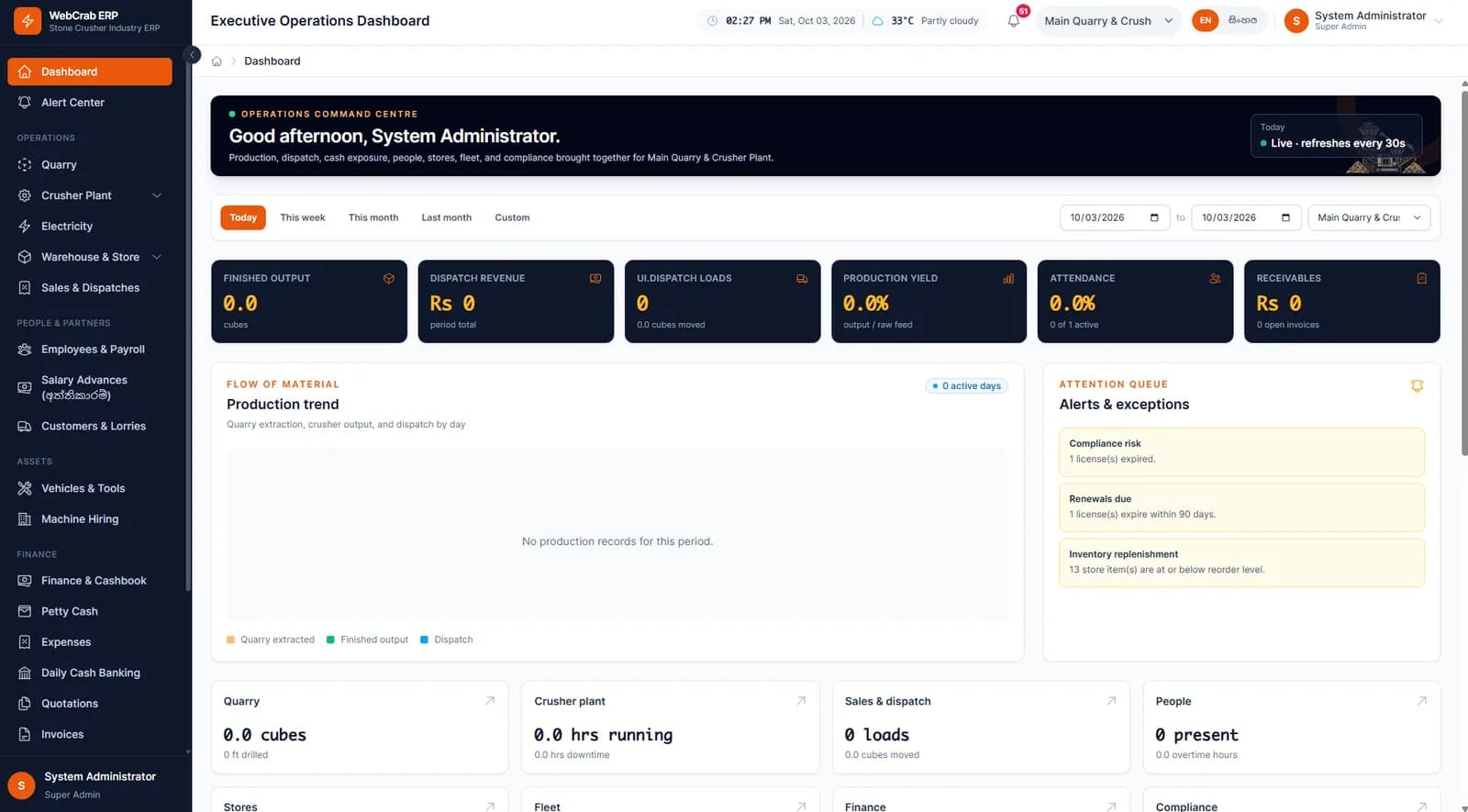
A fully internal ERP, built around how the business actually operates rather than a generic package.
- One system, three locations. Every site works in the same database, with its own stock, staff and daily figures. Head office sees all three at once, and each site sees only its own.
- Automated gate and weighbridge flow. IoT sensors and cameras at the gate capture each vehicle as it arrives.
- Lorry size recognition. Image recognition identifies the size class of each lorry automatically.
- Sales, dispatch and invoicing. Orders, delivery slips and invoices are generated from the recorded load, which removes double entry.
- Inventory and production. Stock of aggregates and materials updates as loads leave, so the quantity on hand is always current.
- Purchasing and suppliers. Purchase requests, approvals and supplier records in one place.
- Machinery and maintenance. Equipment records and service schedules per site.
- Accounts and reports. Daily, weekly and monthly dashboards for the owner, with exportable reports.
Why it matters
Automating the point where material leaves the site removes the most common source of disputes and leakage. Everyone now works from the same recorded event.
How we work on projects like this
We start with a walk-through of each location, map the paper and spreadsheet flows, and build the first module on the site's busiest process. Rollout is one location at a time, with training on site, and the system is hardened and backed up from day one like every Webcrab build.